· publication · 5 min read
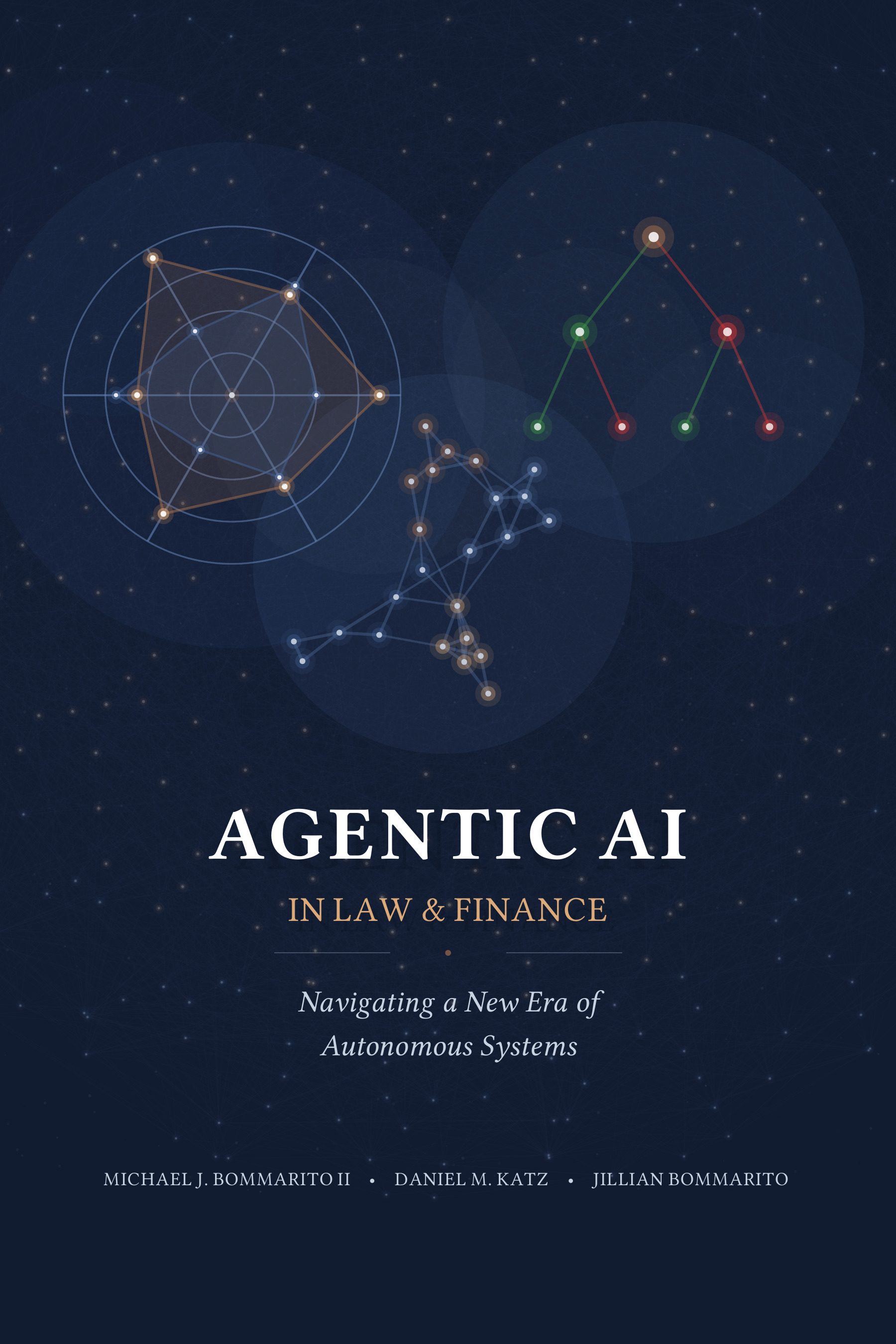
Announcing Our Book: Agentic AI in Law and Finance
Michael Bommarito, Daniel Katz, and Jillian Bommarito publish an open-access book on agentic AI systems in law and finance, available free under CC BY 4.0.

Michael Bommarito
CEO, 273 Ventures
Why We Wrote This Book
Over the past two years, the conversation around AI in professional services has shifted dramatically. In 2023, the focus was on chatbots and document summarization—useful applications, but fundamentally limited. By 2025, the industry is grappling with something more consequential: agentic AI systems that can perceive their environment, reason about goals, and take autonomous action.
This shift has introduced significant confusion. The term “agent” is now applied to everything from a simple prompt chain to a fully autonomous system managing a complex workflow. Vendors use the language of agency to market products that have no meaningful autonomy. Meanwhile, organizations trying to evaluate, adopt, or govern these systems lack a shared vocabulary and a rigorous framework for thinking about what agentic AI actually is and what it can do.
We wrote Agentic AI in Law and Finance: Navigating a New Era of Autonomous Systems to fill that gap.
The Authors
This book is a collaboration between the three co-founders of 273 Ventures:
- Michael Bommarito, CEO, researcher in computational law, and developer of AI systems for legal applications since 2010
- Daniel Martin Katz, CSO, professor of law, and one of the most cited scholars in legal technology and AI
- Jillian Bommarito, CRO, CIPP/US/E, with deep expertise in AI governance, data protection, and regulatory compliance
We bring complementary perspectives: technical architecture, legal scholarship, and risk governance. The book reflects all three.
What the Book Covers
The book is organized around a central thesis: to build, evaluate, or govern agentic AI systems, you need a clear model of what an agent is and how it operates. We introduce the GPA Framework (Goal, Perception, Action) as a practical lens for analyzing any agentic system.
The GPA Framework
Every agentic AI system, regardless of its complexity, can be understood through three components:
- Goal: What is the system trying to achieve? Who defines the objective? How is success measured?
- Perception: What information does the system have access to? How does it observe and interpret its environment?
- Action: What can the system do? What tools, APIs, or interfaces does it control? What are the boundaries of its autonomy?
This framework is deliberately simple. It is designed to be useful to attorneys evaluating a vendor’s AI product, to technologists designing a new system, and to compliance officers assessing risk—all in the same shared language.
Ten Design Questions
Beyond the GPA Framework, the book presents ten design questions that any organization should answer before deploying an agentic AI system:
- What is the agent’s goal, and who defines it?
- What can the agent perceive, and what is hidden from it?
- What actions can the agent take, and what are the boundaries?
- How does the agent handle uncertainty and ambiguity?
- What is the human oversight model?
- How are decisions logged and auditable?
- What happens when the agent fails or produces an error?
- How does the agent interact with other agents or systems?
- What data does the agent access, store, or transmit?
- How is the agent updated, retrained, or retired?
These questions are not theoretical. They emerge from our direct experience building and deploying AI systems for legal organizations, and from the recurring gaps we observe in how organizations evaluate AI products.
Governance Models
The final section of the book addresses governance—how organizations should structure oversight, accountability, and risk management for agentic AI. We draw on existing frameworks from data protection law, professional responsibility rules, and information security standards, while acknowledging that agentic AI introduces novel challenges that existing frameworks do not fully address.
We propose governance models that scale with the autonomy of the system: a chatbot that suggests edits to a contract requires different oversight than an agent that autonomously files regulatory submissions. The governance model should match the risk profile, and the book provides concrete guidance for making those assessments.
Open Access
We made a deliberate decision to publish this book under a Creative Commons Attribution 4.0 (CC BY 4.0) license. The full text is available for free on SSRN and through the companion website.
Our reasoning is straightforward: the legal industry needs a shared foundation for understanding agentic AI. Putting that foundation behind a paywall would undermine the goal. We want every attorney, compliance officer, technologist, and policymaker to have access to these frameworks without barriers.
For those who prefer a physical copy or a Kindle edition, the book is also available on Amazon.
Connection to Our Training Practice
The concepts in this book form the intellectual backbone of our AI training programs at 273 Ventures. Our training tracks for legal professionals, legal technology teams, and developers all build on the GPA Framework and the ten design questions. The book provides the depth; the training provides the application.
Organizations that want to move from understanding to implementation, whether building internal AI strategy, evaluating vendors, or developing custom agentic systems, can engage with our consulting and training practice directly.
Where to Get the Book
We wrote this book because the industry deserves more than marketing language and hype cycles. Agentic AI is real, it is consequential, and it demands rigorous thinking. We hope this book contributes to that rigor.